Monday, 6 January 2020

A review of Irish DNA findings this past decade

As we move onto the new year we look back at the past decade which saw significant progress within the field of population genomics.
At the beginning of the decade the field was practically non existent. Stuck in the mire of old Palaeolithic continuity nonsense espoused by the likes of Stephen Oppenheimer and his colleague Brian Sykes. Similar sentiments existed in the archaeological community, and had done since WWII.
Without any ancient samples as a point of reference, these ‘experts’ based their theories near exclusively on uniparental markers, claiming that haplogroup R1b the dominant lineage of Western Europe was an old Palaeolithic lineage that spread in post-LGM migrations from the Franco Cantabrian refuge, due to it being most prevalent there, so it must’ve come from there.

Right?

Wrong. As it turns out basing one’s finding on just FOUR short tandem repeat Y-chromosomal markers doesn’t really tell you all that much about one’s own genome. Actually looking at the genome tells us more about the genome. There were plenty of burials to plunder for samples. There was just one problem. 
The cost. To sequence a single sample would cost tens of thousands of dollars and the finished product was always vulnerable to contamination, ala Mr.David Reich (pbuh) of Harvard university steps in and completely changes everything with his groundbreaking work. The revolutionary NGS (Next Gen Sequencing) illumina SNP array utilised in UDG (Uracil DNA Glycosylase) treated labs were able to sequence these ancient samples at relatively low cost (under $200 same price for most consumer kits) and to relatively high coverage depending on the quality. By 2013 the genomic revolution had already gone well underway, and it was discovered that Europeans form a genetic cline between three modal “ghost” populations. Geneticists were perplexed by this.
The only thing to do was dig up more samples from various sites across the continent. Since 2013 up until now close to two thousand samples have been sequenced with many more well on the way.

Eventually that year a team of archaeologists dug up the remains of a four year old child buried in the permafrost in a site located in central Siberia associated with the Mal’ta Buret culture. The child had been frozen for close to twenty four thousand years. Reich’s team managed to get their hands on a sample from the petrous bone where the DNA is best preserved and it was revealed this child belonged to a population (dubbed Ancient North Eurasians) that made up one of the particular “ghost” populations ancestral to modern Europeans, as well as to middle easterners and even more so in Native American populations. The boy’s paternal haplogroup was found out to be R* basal to the vast majority of paternal lineages found in European men today (R1a and R1b).
With regards to the autosomes, his DNA was found to be higher in present day Northern and Eastern Europeans (15-25%) and Southern Europeans (5-15%) to a lesser degree, and in Sardinians almost totally absent.
Why was this? Surely these Siberian ice age mammoth hunters had nothing to do with us? How did their DNA get all the way over here in Ireland, and for that matter why are nearly all Irishmen directly descended from them? This is when population genetics really starts to get intriguing. And somewhat also confusing.


Basal rich K7 graph revealing three fold ancient ancestry
in modern Europeans who form a cline closest to the
WHG-UHG/Villabruna related cluster.
The basal rich component refers to the eponymous “Basal Eurasian”
ghost signal, the as of yet to be physically discovered population
diverged from the main Eurasian clade 50-60kya their descendants
subsisting in the middle east somewhere before eventually mixing
with WHG like UHG (Unknown Hunter Gatherers) to form the nucleus of the
Dzuduana/Anatolian cluster, the basal Eurasian signal then eventually made
it’s way into Europe with farming 8,500kya.
As for the Basal Eurasians themselves we still do no know if they even existed,
perhaps this signal being an “artefact” of geneflow back and forth from
the Middle East and North Africa.
Irish are represented by the cross.


Obviously these ANE foragers had no presence in our part of Eurasia, so as always there had to have been a middle man which brought this type of ancestry to Europe. In 2015 a study headed by a team of Irish geneticists at trinity college sequenced four samples from the Neolithic and later Bronze Age. The neolithic woman from Ballynahatty was found to totally lack this ANE component and thus resembled present day Sardinians, whilst the three Bronze Age men that replaced her population scored a significant amount. Even more than modern Irish people as a matter of fact.
Where did these Bronze Age Irish inherit this from you ask? In steppes the Yamnaya culture. (See what I did there?)


Almost no continuity with neolithic Irish.

Strong continuity with Bronze Age Irish.


Amongst the vast majority of archeologists and geneticists. The Yamnaya (Pit-Grave in Russian) herders of southern Russia are the best candidate for spreading Proto-Indo-European dialects into Europe and subsequently after mixing with local farmer populations, bringing proto-Indo-Aryan dialects to central and Southern Asia too, along with their genes. They lived in a predominantly pastoral economy though they occasionally cultivated grains to bolster their food supply. They were a brutal and aggressive people whom championed violence above all things as evidenced by their remains frequently showing signs of blunt force trauma from cudgel like weapons. They buried their dead individually in burial mounds known as “kurgans” and judging from the lack of females found they were likely a patriarchal society, as all subsequent Indo-European cultures were. This is also further evidenced in phylogenetic findings showing these men to belong to the same terminal Y-SNP, implying patrilineality similar to the clan systems of Gaelic Ireland which placed a strong emphasis on a common male ancestor. As it turns out 84% Irishmen also share a common male ancestor with the yamnaya men going back some six millennia ago to somewhere in the pontic steppe region. 
These late PIE populations were themselves roughly 40-50% ANE, and formed a cline between Eastern European hunter gatherers (70% ANE+ 25% WHG+ 5% CHG) and Caucasus hunter gatherers (50% ANE + 50% Dzuaduana like population). Predominantly made up of the former rather than the latter. Men from EHG tribes interbred with women from CHG tribes and resulting meta population expanded into the Don-Kuban region assimilating the EHG rich forager groups there. The ethnogenesis of yamnaya related populations likely occurred like this. 


PCA revealing averages of Yamnaya samples from eastern
Ukraine and southern Russia forming a cline in between
EHG and CHG clusters, notice that the yamnaya samples
are shifted somewhat “southward” due to harbouring
some EEF ancestry from local neighbouring Triploye
agriculturalists.


I, for one, welcome our new steppe overlords.


The first academic to hypothesise these people for being responsible for spreading Indo-European language was ironically feminist Lithuanian scholar Marija Gimbutas, who contrasted them with the opposing “old European” populations of neolithic Europe whom lived in sedentary and agricultural societies counter to the more on the go Yamnaya.
She saw the neolithic farming populations as pacifistic, gynocentric and egalitarian, more sophisticated than the vicious steppe warlords to the east. Despite some evidence to the contrary. 
Even more ironic being that Lithuanians like her are one of the closest modern populations to the yamnayans. Perhaps explaining why they speak one of the most archaic Indo-European languages? 


No wonder Khabib defeated McGregor!


In a massive multidisciplinary study headed by lead geneticist Wolfgang Haak in 2015 entitled “Massive migration from the steppe was a source for Indo-European languages in Europe” (you can read it here) the authors concluded that a majority of Northern/Eastern European DNA derived from these herders, along with Indo-European speech as evidenced by the presence of farmer enriched steppe admixture in Indo-Aryan speakers. The kurgan model of Gimbutas had been vindicated. 
In 2018 a study headed by Iñigo Olalde discovered the middle man for this steppe ancestry found in present day northwest Europeans were bell beaker cultures of Central Europe.
By 2400BC there was at least 90% turnover from local megalithic builders who left little to no introgression into the modern Irish genome. 


My models more or less falling in line
with señor Olade’s findings. 

We have learned a lot in the previous decade of population genomics research and we hope to discover even more about ourselves in this one. 
With the thesis of Lara Cassidy’s “A Genomic Compendium of an Island:Documenting continuity and change across Irish human prehistory” under embargo until May of this year, we will not have to wait long until we get our filthy hands on close to one HUNDRED samples from the mesolithic right up into the medieval period. 
With this publication of so many samples my work on Ireland’s various genomic transitions will be more or less complete. 
Previously Irish scholars maintained that we are Atlantean, when in reality we are Hyperborean. And always have been, whether or not we remain so remains to be seen.

Monday, 9 December 2019

Gaelic Icelanders

Note the positioning of the SSG-A4 sample,
she appears to be super drifted in the direction
of the “Celtic” cluster.

With my sincerest thanks to David of the Eurogenes blog, we are now for the first time ever able to look at at least two relatively pure medieval Irish samples from the mixed Norse/Gaelic colony of Iceland.
Unfortunately they are both very low quality samples, but beggars cannot be choosers of course.
Both samples show a relatively high degree of drift with modern Irish, particularly Irish from Ulster which seems to have been where most of the Gaelic settlers came from.

Genetic distance with modern populations
Global 25 vahaduo tool.


Genetic distance with ancient populations.


If you would like to read the paper featuring these two samples you can do so here.


Update: Global 25 heat maps showing distance to modern populations, the redder the closer.


Wednesday, 13 November 2019

Are the Irish immune to HIV/AIDS?


In light of a recent lecture given by lead Harvard population geneticist David Reich (PBUH) which you can watch here, it would seem apparent that the alleles encoding for greater immunity to infection from HIV (Human Immunodeficiency Virus) the retrovirus responsible for the disease known as AIDS (Acquired Immunodeficiency syndrome) formerly known as GRIDS (Gay related immune deficiency) back when the disease became more widespread in the eighties.
Without going into too much detail, the virus works by hijacking white blood cell’s ribosomes, producing an over abundance of cytokines ergo halting the production of antibodies from T-blood cells and macrophages, leaving the immune system susceptible to otherwise non life threatening pathogens.
However some populations are more susceptible than others.

In the late nineties a link between AIDS progression and the CCR5 gene was discovered by a Harvard team of which David Reich (PBUH) was a part of. You can read the paper here.
Thanks to the recent explosion in available ancient dna samples since then. It would appear the gene may have spread with populations from the Pontic steppe five millennia ago.
Which would’ve led to greater immunity to diseases such as bubonic plague caused by the yersinia pestis bacteria. Giving them an edge over local EEF populations whom they assimilated.
Unsurprisingly the most homozygous population today are Swedes.
The most Indo-European Europeans.


I’ll be posting a vahaduo tutorial later.


The gene itself underwent strong selective sweeps in the past seven centuries , coincidentally around the time of the Black Death. The study in question hasn’t been published yet, but based off this sneak peak it appears the alleles first pop up in the khvalynsk culture in the samara region, a contender for the early PIE urheimet. It later spread with the ancestors of corded ware people, who also as it turned out spread plague to the local EEF. Due to the paucity in Irish ancient dna samples, we don’t have much to go on, but it’s safe to say the gene arrived in the Bronze Age with Rhenish and Maritime beakers from Britanny. As it turns out homozygotes for the derived CCR5-Delta 32 allele positively correlates with steppe ancestry. 


12.4% not great, not terrible.

As you can see one of these Middle Eastern countries is not like the other, granted Ashkenazi Jews do bear some European admixture, mostly from a Southern European like source, have a higher prevalence of homozygotes, despite only around ~15% Northern/Eastern European like admixture.
Perhaps the high frequency of AJ belonging to subclades of haplogroup K might have something to do with it? A study over a decade ago claimed that mitochondria had a role in aiding against AIDS progression. Haplogroups H3,K,X,I,W showing greater resistance. J and U5 less resistance. 
As for what causes the outright immunity, I have no idea and I hope they explain why in the study, otherwise people may start getting the wrong idea and start claiming Jews are just European converts, which of course they’re not.

As for the lucky 12.4% Irish whom are completely immune to HIV, I unfortunately am not one of them. Nice. 

You’ll need to upload 23andme raw data to
Promethease in order to find out if you can engage
in risky lifestyle choices.


Monday, 14 October 2019

The hunt is on

So with the publication of the recent paywall locked Mittnik et al paper on “social inequality in Bronze age Lech Valley” (whatever the hell that means?) we finally have our first R1b-L51 positive call from a confirmed Corded ware sample. Back in 2015 a sample from a Kujavian Corded ware (RISE 1) site in Poland was also deemed to be somewhere downstream of R1b-M269 however unfortunately this was a very low resolution sample that couldn’t be taken too seriously.
Many over the years have denied the ancestors of eastern bell beakers had anything to do with the spread of Corded ware groups from the forest steppe, and instead purported a direct Yamnaya migration from the more open Don-Kuban steppe region through the Balkans and up into the Carpathian Basin. I at one point probably favoured this theory, but not so much anymore. Even the famed Lithuanian feminist scholar responsible for the Kurgan hypothesis believed these bell beakers’ ethnogenesis came about as an amalgamation of Yamnaya and Vucedol populations in the Balkans with the resulting meta population subsequently taking over Western Europe.
And at the time she could be forgiven for believing as such, but she was wrong ultimately, as she also was believing the Globular Amphora culture to have been Indo-European. 
All she had to go on was anthropology, which seemed to suggest that the ultra brachycephalic beakers were of the Dinarid type (at least according to Carletoon Coon) a phenotype most commonly observed in Balkanite populations. They didn’t have WGS technology to work with back then, just good old fashioned calipers. Surely these robust short skulled beaker folk couldn’t possibly have anything to do with those gracile dolicho Nordid people from corded ware? Right? 


We wuz bell beekaz n shiet

These scholars were simply working with the tools they had available at the time. Thankfully we have more tools available to us now. These Yamnaya derived Hungarian beakers completely lack the R1b-L51 found in Rhenish beakers. The naysayers who criticised the Dutch Single Grave model kept pointing to the lack of R1b samples in CWC. And no doubt these people will continue to deny bell beakers were essentially a Single Grave offshoot (Protruding Foot beakers?)
But it appears now we may have found the missing link, in the German Lech valley, an individual dubbed “Tauber ALT_4” has indeed tested positive for at least one Y-SNP R1b-L51 call. As for those claiming that he is some sort of assimilated bell beaker who intermarried with a local CWC girl they are wrong. He has CWC levels of steppe ancestry. Higher than that of Lech valley beakers.

Notice the diminishing level of Steppe
admixture throughout the BA.

The signs were always there of course. A R1b-U106 sample from Beddinge, Sweden (Nordic_LN RISE98) harboured a good chunk of battle axe and funnelbeaker admixture.
Although he could very well have been a recent Danish Single grave migrant.
(He also appears to have been part of a ritual human sacrifice, weird.)

The only question now is to pinpoint where on the PC steppe the ancestors of CWC came from.


Protruding foot vessels, noticeable similarities with
TRB ceramic type.


Update: You can read the latest study on Bronze Age social inequality for free here.

Saturday, 31 August 2019

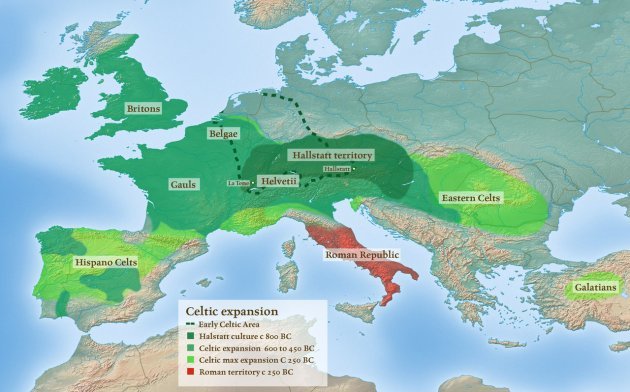
Are the Irish Celts?

Expansion of Hallstatt and subsequent La Téne horizons across Europe.

Probably the most controversial question asked of mainstream Irish academia over the years is as to whether or not that Irish people can be categorised as a definitively 'Celtic' meta-ethnic group.
Until the past few decades, the general consensus amongst Irish scholars was that a migration from somewhere on continental Europe occurred c.500BC and thus with it bringing the precursor of the Irish language. However this theory has since waned in support due to the subsequent backlash of PC revisionism amongst academics during the 1990's. The word 'Celt' was added to the ever increasing list of racial slurs that you couldn't say anymore because it triggered people.
So are we or aren't we? And if not then what?

Well after spending a considerable amount of time playing around with different models on Global 25, I would actually in earnest say yes......but also no.
You see due to the dearth in available samples from prehistoric Ireland at this current moment in time, at least until may of next year when the embargo is lifted on the ancient Irish DNA compendium courtesy of Trinity college's science department, I have to improvise and make do with samples from across Bronze age Britain as substitute proxies. But beggars cannot be choosers I suppose.

In a previous post I mentioned that between now and the early bronze age period, at some point there was an admixture event which led to a 'southern shift' noticeable in contemporary Irish genomes relative to the more 'northern' Rathlin samples who share most drift with Dutch beakers of which Irish score around 80% as on Global 25.
As you can see being isolated on an island for
four millenia has led to a fair bit of drift since then.
Dstats courtesy of Eurogenes blog.
So what caused this southern shift? I think the answer at this stage is fairly obvious. Last year foremost population geneticist David Reich of Harvard commented that during the Iron age in south-east England samples show evidence of a resurgence in EEF like admixture. One of the scenarios postulated was introgression from a remnant neolithic survivor population subsisting on the island, but I think this is unlikely. Given it's closer proximity to the continent, I believe a population of Hallstatt or perhaps even later La Téne Celts (or both) arrived, and mixed with the LBA population, whose mixed descendants then took over the island with their superior Iron technology and chariots.  Gaius Julius Caesar comments in his 'De Bello Gallico' how certain Gallic tribes such as the 'Belgae' made frequent sorties across the channel to Britain.
During the period of the EIA after the collapse of the Bronze age trading networks which connected all of Europe and plunging temperatures resulted in a collapse of the Irish population from a BA high of around 100,000 to perhaps as low as 20,000 people by 300BC. It would not have been particularly difficult for a mannerbund of Iron sword wielding elites from abroad to take over and spread their language, culture and of course genes too.
Something like this is what I believe probably occurred in Ireland which led to a more fractured and tribal lifestyle were petty kingdoms waged war via launching surprise cattle raids on each other. And when modelling Irish using Irish_EBA and various Hallstatt and another attested and surprisingly northern Celtic sample from the Greek colony of Empuriés in Catalonia, this geneflow is very apparent.


In a blog post back in 2018 Davidski (see here) using qpAdmix modelled Iron age samples from Hinxton obtaining similar scores to the one shown above, though on Global 25 the models are not immune to being skewed by genetic drift which these Bronze Age 'Irish' naturally share with these Iron age samples from the continent. So for the most part we can be chalked up as 'Celticised Beakers' (Celts came from Bell beakers anyway) with some later introgression from Norwegian Vikings (I'll be doing a post on this later) and subsequent Anglo-Normans whom resemble the Irish autosomally anyway. 
Thankfully Davidski (PBUH) went through the trouble of revealing this genetic drift between Bronze, Iron and Modern era populations on a PCA chart.

PCA courtesy of Eurogenes blog.

What is apparent to me first and foremost from this is that Irish, Scottish and Welsh cluster closer to the BA cline than both IA Britons and modern English, whom are noticeably shifted towards the Belgian like Hallstatt samples from Bylany. This seems to verify what David Reich stated last year that an admixture event occurred somewhere in the vicinity of SE England and from there, Celtic culture spread out across the Isles and by 300BC La Téne artefacts start popping up in Ireland, probably from across the Irish sea via somewhere in North England. Interestingly a tribe called the 'Brigantes' make a sudden appearance in SE Ireland around this time. Identical in name to the one from northern England fleeing Roman expansion a few centuries later. These Brythonic tribes may have come as refugees and adopted the more archaic Gaelic language, which appears to represent a more basal layer of Celtic language that probably spread a few centuries earlier.
They may also have brought the famed R1b-M222 snp found predominatly in Ulster of which basal subclades are found in Britain, perhaps spreading with La Téne migrants?
But of course aren't we all immigrants afterall? (lol jk)